Showing posts with label farms. Show all posts

Friday, September 11, 2015

Farm Memories

By John E. Calhoun 

The following are several paragraphs about various aspects of farm life during my childhood and young adult years. 

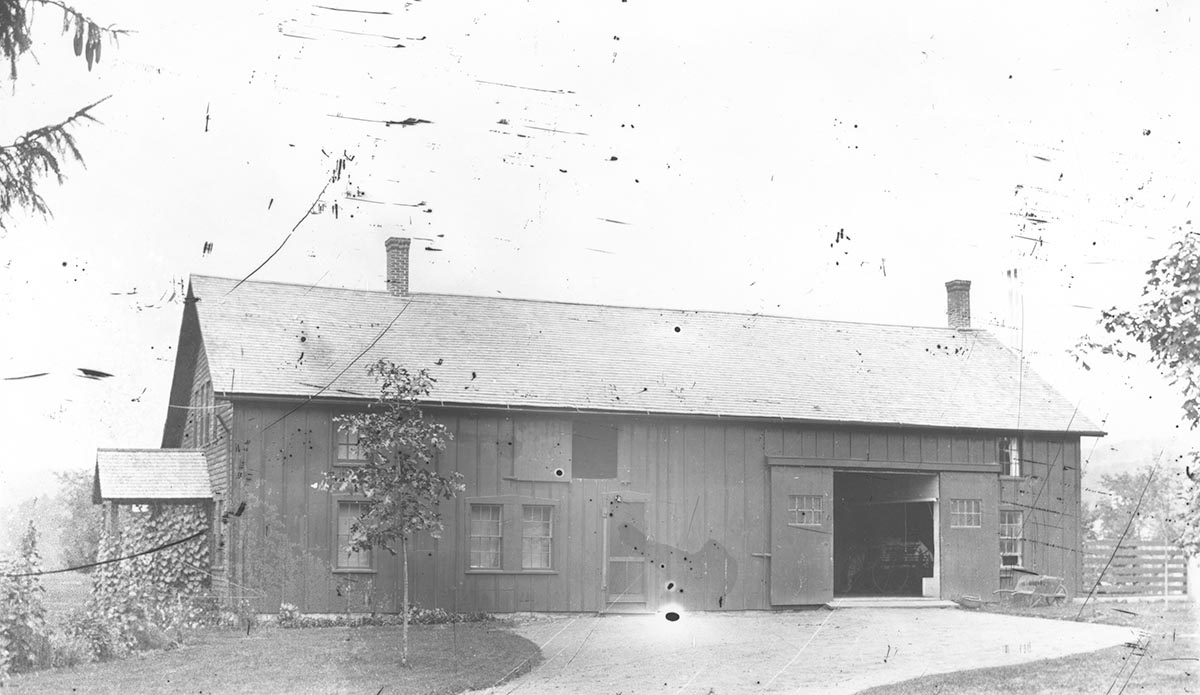
My grandfather, John E. Calhoun, over the course of several years during the 1890s, had built the three barns which exist today in Coltsfoot Valley. The valley barn, now the Neubauer property, was used to raise the young stock - heifers - eventually to be bred for the milking herd in the big barn at the north end of the valley. The middle barn, now owned by Jeff and Gail Jacobson, housed a small herd of Devon beef cows; feed, hay and various implements were also stored there.

Calhoun Barn, Jewell Street, from a glass plate negative, circa 1905.

Friday, August 14, 2015

The Scoville Farm and James Henry Moser's Cornwall Sketches

James Henry Moser, Cream Hill, March 1882
Martha's Album, Collection of Cornwall Historical Society


The Scoville Farm dates back to the 1700s. Ralph Ingersoll Scoville (1829-1887) ran the farm during the second half of the 1800s. In 1870, it was one of the largest dairy operations in Cornwall, with 27 cows producing 12,500 gallons of milk for sale.

Monday, July 6, 2015

Intern Update: A Farmer's Diary

Ryan Bachman, a graduate student at James Madison University, is working as an intern at CHS this summer, creating a Finding Aid to our archives collection. He will be posting highlights from the archives throughout the summer. This is the first post in the series for this year.


The vault at the Cornwall Historical Society is full of diaries and journals written by Cornwall residents over the past two centuries. In 1859, East Cornwall farmer Seelye Hart purchased his first diary from Pratt and Foster’s general store. For the next several decades, Hart kept a daily record of life on his College Street farm. His notes reveal not only the everyday details of operating a nineteenth-century farm, but also a wealth of information on social life in the community. In all, there are six volumes of Hart’s diaries in the historical society vault, and this week’s installment to the historical society blog comes from his first volume.

Page from Seelye Hart's Diary
(Collection of Cornwall Historical Society)

In 1859, twenty-eight year old Seelye Hart and his twenty-six year old wife Jeanette lived on College Street with Jeanette’s widowed mother Marie, their two young sons, Reuben and Elias, and their dog Rover. Every night after work, Seelye sat with his diary and recorded the events that occurred during the day. Topics in Seelye’s entries range from everyday struggles on a New England farm, such as digging large stones out of his fields, to worries that his baby son Elias’ cough may have been indicative of the croup, to musings about Rover chasing woodchucks around the family garden. Entries from the last week of February are especially useful in showing the contrast of hard work and leisure time that Cornwall farmers experienced in the mid-nineteenth century.

February 1859 was unusually warm for northwestern Connecticut. After a long day of work on his farm, Seelye excitedly recorded the happiness he felt working to the tune of “blue birds singing.” In the midst of the unseasonable warm spell, the Hart farm welcomed the birth of three healthy calves. In addition to the newcomers, the Harts already owned twelve milk cows, and after making a delivery to Pratt and Foster’s general store in West Cornwall, Seelye noted matter-of-factly that his farm had sold 3,778 pounds of cheese in the past year—Pratt and Foster used their store’s location along the railroad tracks to ship massive amounts of dairy products to urban locations like New York City. However, the Harts’ lives did not revolve solely around work, as Seelye’s late-February recollections reveal.

On February 24, Seelye and Jeanette left their two sons in the care of their grandmother, and went to a cotillion in Litchfield with their friend Eve. Cotillions in rural New England resembled square dances, and according to Seelye, couples danced to the accompaniment of fiddles, mandolins, and bass viols. The cotillion was held at the home of wealthy farmer, Daniel Dickinson, and lasted late into the night; Seelye and Jeanette didn’t arrive back at their farm until 4:30 AM. In spite of their late night out, they woke up at their usual time later that morning, and Seelye spent the day helping his father build an earthen dam while Jeanette worked at preparing oysters for a family dinner that evening. The cotillion was one of many such events that Seelye and Jeanette spent their leisure time enjoying, and Seelye’s diary is an interesting window into the social lives of farmers in rural Cornwall during the 1850s.  
                       

Friday, February 27, 2015

Mohawk Farms Fancy Butter

Mohawk Farms butter wrapper
Collection of Cornwall Historical Society

Sheldon Clark started making butter at Mohawk Farm in East Cornwall during the mid-1800s. His wife, Melissa, assisted with churning butter. She started making cheese for the family in 1868.

In collaboration with Noah Rogers, Sheldon Clark shipped his butter from the Cornwall Bridge train station to markets in New York and Bridgeport. He eventually scaled back and sold butter only locally.

Sheldon Clark whetting a scythe, c. 1880
Collection of Cornwall Historical Society


Sheldon and Melissa's son, Andrew Clark, took over the farm in the 1880s, producing butter in half-pound and one pound pats, which he delivered to his customer's homes weekly. As with the previous generation, Andrew's wife, Mary Lydia, assisted with the farm, curing the cream daily, stirring it twice each day with a specialized hand tool.

Mary took over the butter business following Andrew's death in 1925, managing to keep it going through the height of the Great Depression with the help of her children and grandchildren. Other family members and friends pitched in as well to help keep the farm producing butter until 1941.


Mary Lydia Clark, c. 1920
Collection of Cornwall Historical Society

Friday, November 21, 2014

Coltsfoot Farm Milk Bottle

Our collections include this fun milk bottle from the Coltsfoot Farm.


Coltsfoot Farm was started in 1885 by John Edward Calhoun, taking its name from the Coltsfoot Valley, where his cattle grazed.


The slogan, "a bottle of milk is a bottle of health," was introduced by the Thatcher glass manufacturing company of New York and soon became a nationally used slogan.

The Calhoun family sold off their dairy cattle and equipment at a two day auction in 1966. The farm property was leased and the dairy operations continued on site by Ronald Laigle, Robert Laigle, and Raymond Thuillard.

Coltsfoot Farm closed permanently in the mid-1980s.


View of Coltsfoot Valley today.

Monday, November 3, 2014

Cornwall's Dairy Farms

Our 2014 exhibit, Cornwall and the Civil War, has come to a close. Although there are a few Civil War "treats" still to come, our focus is shifting to next year's exhibit and programs.

As you might be able to guess from these photos, we'll be exploring the history of Cornwall's dairy farms next year. If you have any photographs, objects, or stories to share, we'd love to hear from you. You can contact our Executive Director/Curator, Raechel Guest, at cornhistsoc@optonline.net.

Cows grazing near Popple Swamp Road, late 1800s.

William Hart dairy farm, 1908.

Cows on the Sandmeyer dairy farm, early 1900s.