PROGRAM
[Letter written by Pvt. Josiah Corban to his wife and
children. Corban was a Cornwall farmer who enlisted in 1862, when he was 41
years old.]
Camp near Fort Worth, Virginia Feb 12th 1862
Dearest of earth, I received yours of the 6th to day and
wonder why it should be so long on its way here. I sent one this morning that I
had written by having two or three spells at it before I finished it. They keep
us very busy now a days so I cannot often get a chance to write but a short
time at once without writing nights, and then I generally have to buy a candle
to see by, if I have a chance to see well enough to write. We use sperm Candles
here, they cost five cents apiece. One will last nearly two evenings if we
don’t sit up long after Roll call, which is at half past eight.
...the Lord only knows what trials we may be called to pass
through before peace will be declared and the Rebels be made to give up their
Rebellion. The Governor of Connecticut, Buckingham, was here yesterday. He came
on to the ground where we were on Battallion drill. In a short time after he
came on to the Parade ground. We were ordered to form a square, and he and
those that were with him besides all our Commissioned Officers went inside the
square. The Lieutenant Col. introduced them as well as all the rest of us to
the Chief Magistrate the Governor of Connecticut William A. Buckingham and told
them they could speak to him, any of them that wished to. The Captains and
Lieutenants all went up and shook hands with him and some of them talked with
him a few minutes. Then he took off his hat and made a short Speech to us. He
spoke with a great deal of feeling in our behalf and told us how much he
thought of us as well as all the rest of the troops from our state and said
that he would be glad to shake hands with every one of us. He praised us for
our Patriotism in leaving our homes and friends to come down here to fight for
our Country and said if we never went to the field of battle we were doing as
much good as if we did. He said it was better to sacrafice [sic] a whole
Generation than to have our Government destroyed. He is a plain looking man and
I don’t think it makes him feel lifted up any by being Governor. He did not
talk as if he had any idea of the North ever giving up the Contest till the
Rebels are Conquered and made to return to the Union. It brought tears to my
eyes to hear him speak of the loved ones at home. It touches my feelings very
sensibly to hear anything that relates to my loved ones at home for they are
nearer my heart than any other earthly object. May God grant that I may meet
them and all the rest of my friends once more in Cornwall, and also in Heaven
at last.
Yours with undying affection,
J. B. Corban
[Song]
Henry Clay Work’s “The Girls at Home.”
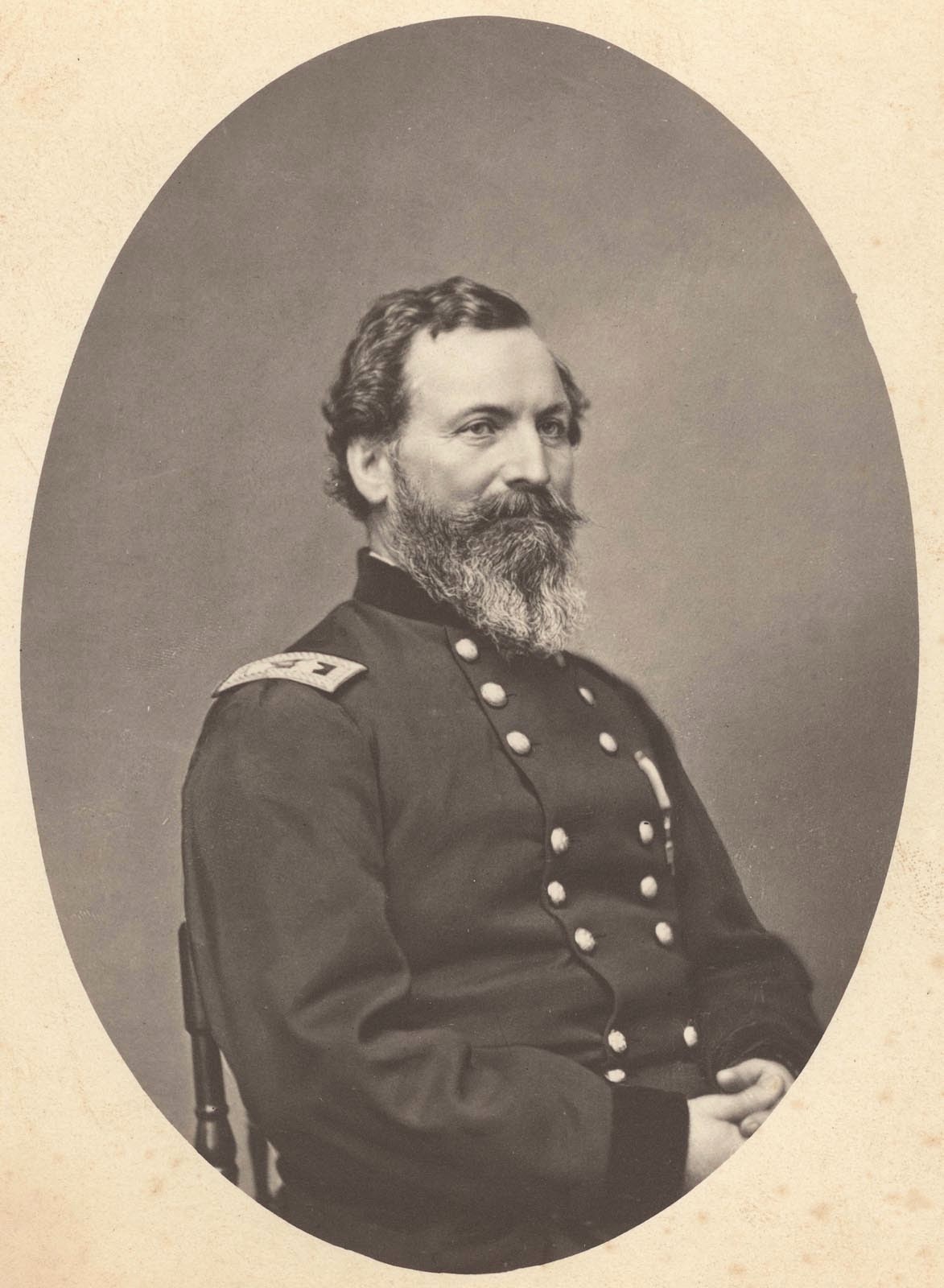
[Letter written by Brigadier General John Sedgwick to his
sister Emily, following the First Battle of Bull Run, the first major battle of
the Civil War.]
Washington, D.C., July 23, 1861
My dear sister:
Our army has suffered one of the most terrible defeats on
record—one of the most disgraceful! We have lost everything, even our honour.
When I last wrote you the army had marched in high spirits,
and every one predicted a prosperous result, and some little success was
obtained; but a panic seized the volunteers, they threw away everything they
had, and fled in terrible disorder. Whole regiments fled without giving a shot
or getting near the enemy. Our artillery behaved bravely; they maintained their
position till they lost so many men and horses that many were obliged to leave
their guns. The loss of property was immense; it is hoped the loss of life not
great, but no reports are made yet. We are disorganized, and if the enemy had
not suffered severely, as we hope they have, they could have marched into
Washington last night. I went to bed night before last believing that
everything was going on well, and yesterday was ill in my room all day till
three o’clock, when I learned of the terrible disaster. I have no heart to
write more.
Your affectionate brother,
J.S.
[Song]
George F. Root’s “The Prisoner’s Hope.”
[Letter written by Josiah Corban while recovering in a
military hospital after being released from a Confederate prison camp]
Annapolis Junction, Dec. 10th 1864
Dear Wife & Children
I thought I would write a few lines again this morning &
send so you need not be looking in vain for news from me. I can’t tell much but
I suppose just seeing a few lines I have written will be better than nothing.
The Doctors, one of them, came around yesterday to get the names of the Parole
Prisoners; also when & where they were captured, when & where released,
so they could make arrangements to pay them all their back pay & also their
ration money while they were prisoners. They are going to pay us up pretty
soon, & then give us 30 days furlough to go home. That is an order from the
war department. & I suppose I can have another furlough if I want it. We
all have to wear Hospital shirts. I wear a woolen one under the cotton one that
they furnish. They brought in some Drawers but they were so short & small I
could not wear them. The most of them were just so, but I shall get along if
they will let me wear my own. ...My boils have got pretty much done running,
but I am so sore yet I can’t sit with much comfort & my Scurvy comes out as
bad as ever yet. How long it will continue so, I don’t know, but guess the way
I am doctering for it will prove a remedy after a while. I have only just begun
on my butter & my Sausage... I shall have to let some one help [me] eat it,
I guess, for they don’t allow me to have much meat & I intend to be as
careful as possible about eating such things as will hinder me about getting
rid of my scurvy. I suppose that will be one thing that will worry you for fear
I will be imprudent about eating, but you need not worry for I don’t mean to. I
begin to feel as if I could not wait much longer to get a letter from home.
Suppose I may have one [waiting] at the Parole camp, hope they will send it
here shortly.
Keep up good courage & trust in God for protection &
he will sustain you through every trial. Yours the same as ever with much love
to all,
Josiah B. Corban
[Song]
“The Brass Mounted Army”
[Letter written by Mark Nickerson to his niece in 1910,
describing his experiences at the Battle of Malvern Hill on July 1, 1862]
Many of the men dropped on the ground and were soon fast
asleep— others were talking in low tones, telling their Chums what to do, or
where to write in case they were killed. I had a package of letters I had
received from my young Lady Friends—I tore them up into small pieces +
scattered them on the ground. No one should read those letters if I was killed.
As we lay there in the woods, the silence was oppressive—not a leaf stirred on
the trees—not a puff of air—the only sounds we could hear, was the low subdued
tones of the men talking to each other, + off to the front in the woods, we
could hear at a distance what sounded like the tramping of Soldiers + giving of
orders. It was the calm before the storm. As the ominous sounds in the woods on
our front grew louder + seemed to be coming nearer, the men who were asleep
were quietly awakened, + we were all told to examine our guns. The Rebs had set
out on this Campaign to crush the Army of the Potomac + we knew full well that
they would not give it up without another bloody Battle. So here we were
awaiting the attack. We had been able to get but little snatches of sleep for 7
days + nights. Most of that time we had been on the move. Our Haversacks were
empty + we had been out of rations for 24 + 36 hours. We were a hollow-eyed,
wild looking set of men, + a dangerous set to tackle. Suddenly the storm broke
in all its fury, like a thunder shower in Summer when the wind gets into it +
brings it up from the North West, only a thousand times more fearful than any
thunder Shower. At a given signal, Battery after Battery came out of their
hiding place on a gallop, wheeled quickly into position + limbered up for
action. The Infantry came out of their hiding places, + quickly formed in line
of Battle. ... As we were marching by the flank to take our place in line of
Battle, I noticed running Black Berries on the ground and stooped down several times
to pick a Black Berry, as I was hungry + Thirsty. The Orderly Sergeant spoke to
me quite sharply, + told me to mind what I was about. I told him I knew what I
was about, + before the Battle was over had had a chance to see that I knew
what I was about.
Before reaching our lines the Rebs had to cross quite a
large open field in range of our Artillery, and when near to our lines, they
would be lost to our sight for a short time, as they crossed a lower stretch of
ground, then they would come into plain view again on a level with our line of
Battle. It seems terrible to think of now the way those brave men were cut down
by the fire of our Artillery to say nothing of the Rifle fire from the
Infantry, but we Just gloried in it then. Our fighting blood was up. They were
after us—would kill us if they could—and the more we killed of them the better
chance we stood for our own lives.
[Song]
Walter Kitteridge’s “Tenting Tonight on the Old Campground”
[Letter from Corporal Joseph Payne to his cousin Samuel F.
Gold]
Camp near Alexandria, Va
December 13th 1862
Dear Cousin Sam,
I received your welcome letter yesterday the 12th and was
happy to learn that you were well and thriving. I hope you will continue so and
I hope also that we shall meet again both of us hale & hearty. I am very
well now. I have had some cold but it is now disappearing fast. I weighed 160
when I entered the U.S. Service. I now weigh 183: a gain of 28 lbs, which isn’t
so slow, taking into consideration the diet furnished by Uncle “Sam”. But we
that is the 19th ought to be thankfull for the good fare we have had compared
with other Regiments. Since we have been here we have had good nice bread, good
pork, occasionally potatoes and beef; but the beef, I might say, is old enough
to speak for itself. In addition to this we have Sibley tents, stoves and
plenty of good wood. Oh as long as we live here we certainly cannot complain
but somehow this kind of life don’t seem to satisfy, to be sure. It is
perfectly safe here, but deeds of bravery and scars are an honor to a person,
therefore I think I should like to be with Burnside, where things are stirring
now. I expect success attend his efforts. You asked me my opinion of the
removal of McClellan. I like the idea very much. He no doubt was or is a good
general, but too slow for the present time and emergencies. Burnside I believe
is the man for the times, quick to take advantage of any and all successes
which he may achieve. We have good telegraphic news from Burnside to night but
somehow the operators won’t tell us what it is, only that it is good, with
which we have got to be satisfied for the present. The reason why I made that
mistake in directing your letter was that I sent the letter to the Capt [Edward
F. Gold] to read and he lost it and I had to direct the letter from memory.
The Capt is well and growing fat every day. Our Co., those
who you are acquainted, are all well. I believe some of them have been sick but
all have now pretty much recovered their health. I shall be very happy to
receive your picture. I will send you another one soon after receiving it you
much been[?] the first one up. Give all my love to all of your folks. Write
soon.
I remain Truly yours,
Cousin Joe
[Song]
George F. Root’s “The Battle Cry of Freedom”
[Letter from Sedgwick’s aide, Capt. Richard Halsted, to
Sedgwick’s sister, Emily]
Camp Near Berlin, Maryland, July 17, 1863
My dear Miss Sedgwick:
As you no doubt already know, from newspapers if not from
letters, we have been for the past few weeks having a very active campaign, so
far as marching is concerned at least. It does now and then occur that
well-ordered marches as effectually beat an enemy as the most decisive battle
could do, and something must be set down to the saving of life. There is not much
doubt that some of our marching has been much to Mr. Lee’s damage, but still
the battle of Gettysburg had to be fought. No amount of marching with the
forces we then had could have obviated the necessity for a fight like that one
somewhere. It was a terrible fight. The losses show that. The common talk among
the prisoners taken by us is that Lee lost at Gettysburg alone not less than
thirty thousand men. Our own loss is about twenty thousand men. I wish I could
give you an idea of the artillery fire. It was terrific. We at the 6th Corps
headquarters were in a good position to judge of it, for, singular as it may
seem, almost the only spot along the whole line not under fire was that
occupied by us. ...I cannot tell
you anything of any consequence about the fight. Some of the newspaper accounts
were very good. I saw so little of it that I cannot describe it. Our progress
in pursuit of Lee was necessarily slow and cautious. Two such armies, having
fought each other so often, having known each other so long and intimately,
cannot very well afford to play at fast and loose.
Now, as I write, a staff-officer from headquarters comes to
bring information which looks to an immediate move—to-day, if possible.... The
officer does not know the direction in which we are to go. I wish that one
small portion of the 6th Corps might move in the direction of, and have for its
ultimate destination the region known as, Cornwall Hollow....
Very sincerely yours,
R.F. Halsted
[Song]
E.W. Locke, “We Will Not Retreat Any More”
 |
| "We will not Retreat any More," sheet music sent to Miner Rogers in Cornwall by Sgt. William Cogswell in Washington, D.C., 1862 |


.JPG)
.JPG)


.JPG)